What Wildwood Land Zoning Means for Acreage Buyers
August 13, 2026
August 13, 2026
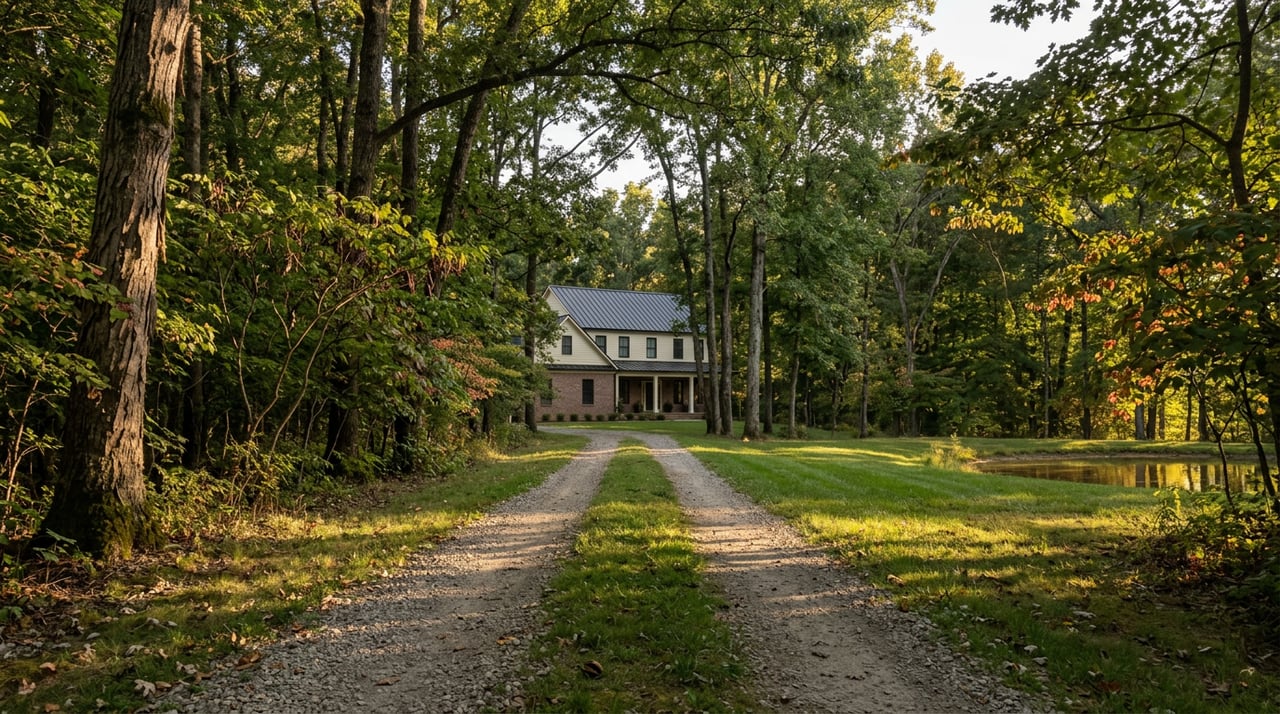
You're standing on a wooded three-acre lot off a gravel spur road in Wildwood, the kind of parcel that photographs well from a drone and even better in person. The agent mentions the elevation, the tree cover, maybe a walkout site for an atrium ranch. You start doing the math anyone does with land this size: guest cottage, maybe a weekend rental to offset the note. Then you read the zoning code, or someone reads it for you, and the plan stops cold. In nearly every residential zoning district in Wildwood, that math was never legal to begin with.
That single fact is the thing most comparisons of Chesterfield and Wildwood skip past, because it doesn't show up on a listing sheet or a median-price chart. It shows up in the municipal code. And once you see it, it changes how you read every acreage listing in the city.
In August 2022, Wildwood's city council passed Ordinance #2718, which amended the zoning chapters governing the city's core single-family residential districts, R-1A, R-2, R-3, R-4, and R-6A, to add identical language to each: no single-family dwelling in that district may offer a guest room for short-term rental to a transient guest. The ordinance's own preamble states the intent plainly, describing a city that "has always recognized the priority to protect its residential areas from commercial intrusions" and citing short-term rentals as a use that "has proven to be disruptive in certain instances across the United States."
This wasn't a reaction to a single bad Airbnb weekend. It was a deliberate rewrite across five separate residential zoning classifications, all in the same bill, all with the same prohibition. If you're evaluating a property in one of those districts with an eye toward rental income, the zoning code has already answered the question before you've made an offer.
The rental ban isn't an isolated policy. It sits inside a broader pattern in how Wildwood's zoning treats land. The city's Non-Urban Residence District, one of its large-lot classifications, defines a legal "farm" as requiring a minimum of five acres, a threshold that came up explicitly in a 2015 Planning and Zoning Commission proceeding over a property whose owners kept llamas on land smaller than that minimum. Below five acres, keeping livestock as part of a working farm isn't a zoning option, no matter how rural the setting looks.
The subdivision code carries the same logic further. Wildwood's development regulations state that any parcel divided from a larger tract must still meet the minimum lot dimensions and area requirements of its zoning district. A wooded 19-acre tract currently listed off Fox Creek Road makes the point directly: it's marketed as three tax parcels intended to split into roughly three-acre building sites, not whatever configuration a buyer might prefer. The district's per-lot minimum sets the ceiling on how many homes that acreage can ever support, no matter how the current owner divides it on paper.
Put the rental ban and the acreage rules next to each other and a pattern emerges. Wildwood's zoning isn't neutral about how land gets used. It was built to keep large parcels large, keep single-family homes as single-family homes, and keep short-term commercial activity out of residential neighborhoods. Chesterfield, a few minutes east, took a different path. Established in 1988 and built out largely as planned subdivisions and the retail corridor known locally as Chesterfield Valley, its zoning was shaped around density and commercial proximity from the start. Neither approach is better. They're just aimed at different outcomes, and that difference is what a buyer is actually paying for when they compare a listing in one city to a listing in the other.
Land pricing across Wildwood reflects this. Current listings put the average asking price for residential land in the city at roughly $100,274 per acre, based on active listings tracked by LandSearch, while land specifically marketed as farmland runs higher, averaging about $148,475 per acre. That gap matters. It suggests buyers aren't just paying for dirt and privacy. They're paying for a zoning environment that keeps the surrounding land in the same large-lot, low-density condition indefinitely, because the code makes it hard for a neighbor to subdivide down to something denser or convert a property to short-term rental use.
Named subdivisions on the market right now show the range. Timbers at Fox Mountain, served by the Rockwood School District, currently has an 11.5-acre wooded lot listed with paved road access. Estates at LaSalle is offering wooded, sloped building sites aimed at custom home construction. West Eden and St. Albans Forest round out a handful of established subdivisions where buyers are purchasing land specifically for its size and privacy, not its rental upside. Compare that to Chesterfield, where the inventory skews toward established subdivisions like Wildhorse Village and Kehrs Mill Estates, built for turnkey single-family living close to retail and interstate access rather than acreage.
| Chesterfield | Wildwood | |
|---|---|---|
| Typical lot character | Standard subdivision lots, condos, townhomes | Large-lot districts, acreage parcels, wooded tracts |
| Short-term rental status | Outside the scope of Wildwood's 2022 ordinance | Prohibited in R-1A, R-2, R-3, R-4, R-6A districts |
| Land use philosophy | Density and commercial proximity | Preservation of large-lot, low-density character |
| Buyer profile land tends to attract | Move-up buyers, retail-adjacent living | End users building custom, not investors |
None of this happens in isolation from the wider St. Louis market. As of the St. Louis REALTORS association's June 2026 report, covered by First Alert 4 on July 20, 2026, median sold prices across the association's full coverage area rose 4.5% year-over-year to $350,000, with new listings up 8% and inventory up 10.5% from the year before. That's a metro loosening slightly after several tight years, giving buyers more room to shop and compare than they had in 2022 or 2023.
Inside that loosening market, Chesterfield and Wildwood are moving on different tracks precisely because their zoning steers different kinds of supply. Chesterfield can add density through subdivision and infill because its code was built to allow it. Wildwood can't, by design, which is exactly why its acreage listings keep commanding a premium even as the rest of the metro sees more breathing room. The zoning isn't a footnote to the price. It's a structural reason the price behaves the way it does.
If you're comparing these two cities as a buyer, the question isn't only "what does the median price get me." It's "what does the zoning district actually let me do with the property once I own it." A three-acre lot in Wildwood and a comparable-priced lot in Chesterfield are not interchangeable assets, even when the sale price lines up. One comes with real limits on subdivision, rental use, and agricultural activity that are written into the code, not left to a homeowners association to decide later. The other was built from the ground up to support exactly the kind of turnkey, close-to-retail living that Wildwood's code was written to keep at arm's length.
Neither approach is wrong for every buyer. It depends on whether you're looking for land that holds its character because the code protects it, or a home that puts you closer to the parking lot at Chesterfield Valley on a Tuesday night. What matters is knowing which one you're actually buying before you've made an offer based on a plan the zoning code already ruled out.
Does Wildwood's short-term rental ban apply everywhere in the city? The 2022 ordinance specifically amended the residential zoning chapters covering the R-1A, R-2, R-3, R-4, and R-6A districts. Those cover the bulk of the city's single-family neighborhoods. If you're considering a property zoned differently, confirm the classification with the city's Planning and Zoning Commission before assuming the same restriction applies.
Can I split a large Wildwood parcel into multiple lots? Only down to whatever the property's zoning district allows as a minimum lot size. Wildwood's subdivision regulations require every new lot created from a larger tract to independently meet the area and dimension requirements of its zoning classification, so a large wooded parcel in a district with a one-acre or five-acre minimum won't yield more buildable lots than that math allows.
Why does land in Wildwood cost more per acre than it looks like it should? Part of the answer is scarcity created by the zoning itself. Large-lot districts and subdivision rules limit how much new large-parcel inventory can come to market, and the short-term rental ban removes a category of investor buyer that might otherwise bid prices up further in a different direction. What's left is a market of end users paying for land that the code is built to keep large.
If you're weighing a move between these two cities, or trying to figure out what a specific parcel's zoning actually allows, that's exactly the kind of question worth working through before you write an offer. Kristen Weld has spent years in these two submarkets and can walk you through what a property's zoning district really means for your plans. Let's Connect.
Stay up to date on the latest real estate trends.
Whether you are buying or selling, we treat your real estate goals as our own. We combine deep local expertise in Chesterfield and Alton with a highly tailored, stress-free approach. Let’s collaborate to turn your next move into a seamless success story.

KRISTEN WELD
ADDRESS
16091 Swingley Ridge Rd Ste 210
Chesterfield, MO 63017
3644 Fosterburg Rd
Alton, IL 92002
Mon - Sun: 7AM - 10AM