Clayton and University City Have Two Different Reasons to Distrust Their Median Home Price
August 20, 2026
August 20, 2026
Clayton's median home price rose 145.3 percent in a single year. That sounds like a neighborhood on fire. It isn't. It's twelve houses.
In February 2026, Redfin recorded a median sale price of $720,000 in Clayton, up from a much lower figure the year before, based on just 12 closed sales for the month, compared to 7 the year before. That is not a market trend. That is a small, mixed batch of transactions where a couple of high-end closings can swing the "median" by six figures overnight. Anyone using that number to plan a purchase in Clayton is standing on a number that moves for reasons that have nothing to do with what a typical home there actually costs.
Just west, University City has the opposite problem. Its transaction volume is healthy and its median sale price sits in a believable, stable range. The trouble is that the number describes two neighborhoods that barely resemble each other, split by one street.
If you are comparing these two communities, you need to know both failure modes before you trust either headline number.
Clayton doesn't sell a lot of houses in any given month. That's the root of the volatility. When a market only closes a dozen or so transactions, the mix of what happens to sell that month determines the median far more than any underlying shift in value. A month heavy on downtown high-rise condos looks completely different from a month heavy on single-family estates in the Moorlands or Clayton Gardens, even if home values themselves haven't moved at all.
A more recent snapshot backs this up. A local brokerage's Clayton market tracker, pulling from Doorify MLS data for the period of June 18 to July 18, 2026, showed the average sale price at $417,312, up 31.7 percent from the prior reporting window, with days on market down 17.7 percent in the same stretch. That is a wildly different number from the $720,000 median reported five months earlier, and both are accurate. They just describe different slices of a thin, uneven market.
Zoom into a single submarket and the effect gets sharper. One Redfin snapshot focused specifically on the Downtown Clayton submarket showed only six closings in a recent month, at a median price of $1.2 million. Six sales. That's not a data point, that's a small sample doing what small samples do.
Part of why the mix keeps shifting is that Clayton's housing stock itself is changing underneath the transaction data. Downtown Clayton has been mid-build on roughly seven separate development projects worth close to $600 million, according to reporting from the St. Louis Post-Dispatch, including the $250 million twin-tower Forsyth Pointe and a mixed condo-and-hotel project from Green Street Real Estate Ventures and Midas Enterprises at North Central and Forsyth Boulevard, adding 73 condos alongside a 180-room hotel. A separate proposal from Revive Capital Development would bring a 21-story, 299-unit apartment tower to 111 S. Meramec Avenue.
Newer boutique buildings are entering the mix too. The Forsythia on the Park, a 38-unit condo building, is delivering units finished with Wolf, Sub-Zero, and Cove appliance packages, right alongside established luxury towers like Whitehall and The Crescent that have anchored Clayton's high-rise condo market for decades. An older conversion unit and a brand-new penthouse can both close in the same month and land in the same "Clayton" statistic, even though they sit in entirely different price tiers.
When your monthly sample size is small and your product mix spans decades-old conversions to brand-new construction, the "median" isn't tracking appreciation. It's tracking which building happened to close escrow that month. This matters for anyone budgeting a Clayton purchase: the citywide number is close to useless without knowing which building type, which block, and which construction era you're actually shopping in.
University City doesn't have Clayton's volume problem. What it has is Delmar Boulevard.
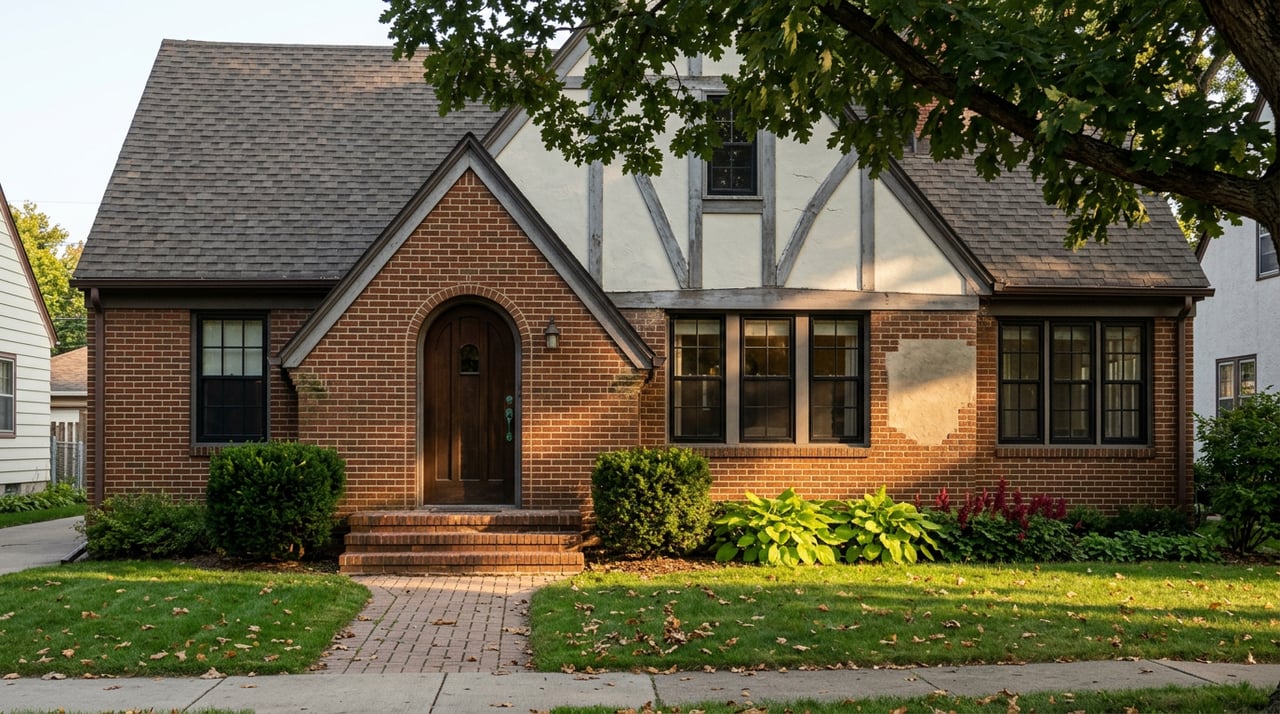
South of Delmar, the housing stock leans toward larger, older Tudor Revival and Colonial Revival homes that can reach past $1.2 million. University Heights No. 1, one of University City's earliest planned subdivisions, dating to the early 1900s and sitting just west of the Delmar Loop, fits that pattern: homes there commonly run from around $500,000 into seven-figure territory. The Ames Place historic district carries a similar profile of large, detailed Tudor-style homes.
North of Delmar, in the North Central neighborhood along Olive Boulevard, the housing stock shifts to smaller mid-century ranches and bungalows built mostly between the 1940s and 1960s, with typical prices in the $100,000 to $350,000 range.
That's not a small gap. That's two different housing markets sharing a single city name and, in most published reports, a single blended median.
| South of Delmar | North of Delmar | |
|---|---|---|
| Typical housing | Tudor Revival, Colonial Revival, larger multi-story homes | Ranch and bungalow, single-level |
| Typical build era | Early 1900s to 1920s | 1940s to 1960s |
| Typical price range | $500,000 to $1.2 million+ | $100,000 to $350,000 |
A citywide median sale price for University City has recently been reported in the low $300,000s to mid $300,000s, depending on the reporting month and source. That number is a mathematical midpoint between two markets, not a description of either one.
The Delmar Loop area adds a third wrinkle. Loop-adjacent neighborhoods carry some of University City's highest median values, with NeighborhoodScout putting the Delmar Loop's median real estate price around $515,000 and the Delmar Loop East pocket closer to $556,000. But both areas also carry unusually high vacancy rates, 20.9 percent in the Loop and 12.2 percent in Loop East, which NeighborhoodScout attributes in part to new construction that hasn't yet filled up. A new 259-unit building, LOCAL on Delmar, is scheduled to deliver near 6650 Delmar in 2026, which will add to that inventory before it stabilizes. A high median next to a high vacancy rate is its own kind of warning label. It means fewer comparable sales are setting that price, and new supply could shift it again quickly.
Then there's Parkview Gardens, a federally designated National Historic District in eastern University City built in the 1920s as a streetcar suburb, originally around 300 brick multifamily buildings and roughly 26 single-family homes, according to the Parkview Gardens Association, which has worked on neighborhood preservation since 1980. It's a distinct pocket with its own architecture and its own pricing logic, sitting inside a city whose "median" doesn't have room to describe it.
If you're deciding between Clayton and University City, the citywide or downtown-wide median is the wrong starting question in both places, just for different reasons.
In Clayton, ask what's actually been selling in the specific building type or block you're considering, not the citywide average for the month, since a handful of luxury closings can distort that number for weeks.
In University City, ask which side of Delmar Boulevard you're looking at before you look at any price at all, since a single citywide median is quietly averaging a $200,000 bungalow market with a $1 million Tudor market.
Neither city is more or less affordable than the headline suggests. The headline just isn't measuring what you think it's measuring.
Why did Clayton's median price jump so much in one year? Mostly because so few homes sell there each month that a handful of higher-priced closings, often in newer condo buildings, can swing the reported median by a large margin without reflecting a real shift in what typical homes are worth.
Is University City's median price a fair number to budget around? Only if you already know which side of Delmar Boulevard you're shopping. The citywide figure blends two very different housing types and price ranges into one number.
Does new construction in either city affect current pricing? Yes, in both places. Clayton's downtown development pipeline is adding new condo and apartment inventory that changes the mix of what sells each month, and University City's Loop-area construction is adding units to a submarket that already carries a higher-than-average vacancy rate.
If you're weighing Clayton against University City, or trying to figure out which specific block or building type actually fits your budget, that's exactly the kind of comparison that benefits from someone who tracks these submarkets month to month rather than relying on a single citywide number. Kristen Weld has spent more than 17 years working buyers and sellers through exactly this kind of decision across the St. Louis region. Let's Connect and figure out what these numbers actually mean for your search.
Stay up to date on the latest real estate trends.
Whether you are buying or selling, we treat your real estate goals as our own. We combine deep local expertise in Chesterfield and Alton with a highly tailored, stress-free approach. Let’s collaborate to turn your next move into a seamless success story.

KRISTEN WELD
ADDRESS
16091 Swingley Ridge Rd Ste 210
Chesterfield, MO 63017
3644 Fosterburg Rd
Alton, IL 92002
Mon - Sun: 7AM - 10AM